Wednesday, July 15, 2009

Indeterminacy 49


I went to a concert upstairs in
Town Hall. The
composer whose works were being
performed had provided program
notes. One of
these notes was to the effect
that there is too much pain
in the world.
After the concert I was
walking along with the composer
and he was telling me
how the performances had not been
quite up to snuff.
So I said,
“Well, I
enjoyed the music,
but I didn’t agree with that
program note about there being
too much pain in the world.”
He said, “What?
Don’t you
think there’s enough?” I
said, “I think
there’s just the right amount.”

- John Cage

Kate Moss irrégulière

Berlin Express (1948)


A multinational group of train passengers become involved in a post-World War II Nazi assassination plot.

Remarkable for some Noir photography and having been shot in the actual German post-war ruins, but otherwise the plot is quite awkward and implausible.

Who's That Girl?

New stuff

Tuesday, July 14, 2009

Wakeema Hollis


Indeterminacy 20


Well, since Darmstadt, I’ve written two pieces. One
in the course of a fifteen-minute TV program in
Cologne. The other is Music Walk, written during two
hours in Stockholm. Neither piece uses chance
operations. The indeterminacy in the case of Music
Walk is such that I cannot predict at all what will
happen until it is performed. Chance operations are
not necessary when the actions that are made are
unknowing. Music Walk consists of nine sheets of
paper having points and one without any. A smaller
transparent plastic rectangle having five widely
spaced parallel lines is placed over this in any
position, bringing some of the points out of
potentiality into activity. The lines are ambiguous,
referring to five different categories of sound in
any order. Additional small plastic squares are
provided having five non-parallel lines, which may
or may not be used to make further determinations
regarding the nature of the sounds to be produced.
Playing positions are several: at the
keyboard, at the back of the piano, at a radio.
One moves at any time from one to another
of these positions changing thereby the
reference of the points to the parallel lines.

- John Cage

Margaryta Senchylo

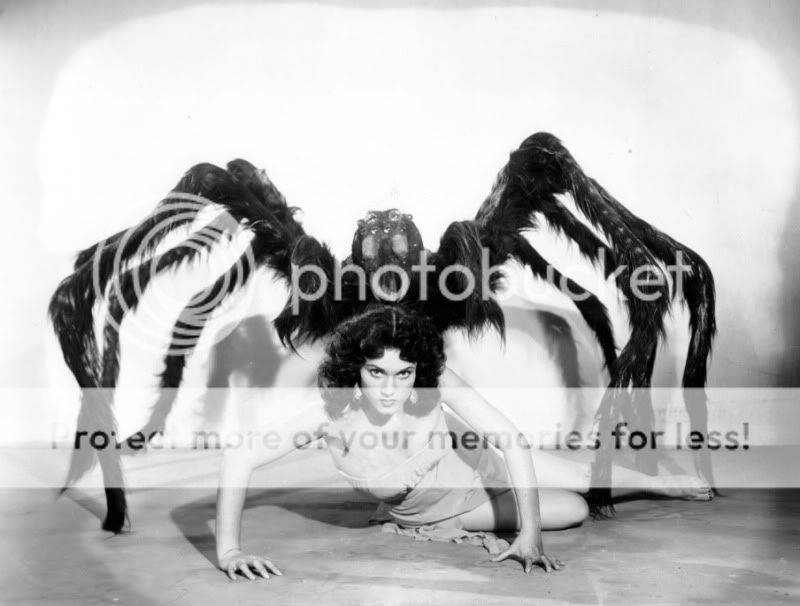
Mesa of Lost Women (1953)


A mad scientist is creating giant spiders and dwarves in his lab on Zarpa Mesa in Mexico.

Yep, it's very bad, very weird and absolutely ridiculous, but quite entertainingly so.

Tanya Pilyukova