Showing posts with label Books of My Life. Show all posts

Wednesday, December 5, 2012

Saturday, August 27, 2011

Books of My Life: H.G. Wells


This is not about a singular book, but about 3 novels by H.G. Wells in the Berkley Highland mass market paperback editions. I bought and read them, when I was 9 years old. For many years they were the most cherished books in my possession till my Dad one day gave them away to the library of the German-American Institute here in Regensburg. They might still be there,

As many boys at that age I was an enormous fan of science fiction, and before I started reading these books, I had already seen the film adaptations. I guess I came upon H.G. Wells as the auther responsible for these movies and assumed (naively, but quite correctly) that this must be an important name in science fiction. The book covers of these Berkley Highland editions were so thrilling I had to get the books, and even when I was not reading I'd spend a lot of time simply delving into the fantastic world of these cover illustrations. I'm not certain, but I think the artist of these book covers was Richard Powers.

I can remember two stories concerning these books. I was in the 3rd grade at St. Peter's School in Kirkwood, Mo., and one of my best friends was an African-American kid with the name of Clarence Smallwood. His older borther was in the 8th grade and heard that I have these H.G. Wells novels, and so he borrowed The Invisible Man from me. Many weeks later my class teacher Mrs. Burke came to me before class, handed me the book and told me an 8th grader was giving this back to me with thanks. She was absolutely perplexed and a bit disbelieving that I was reading such literature. Although it was a bit flattering, I was more concerned about the condition of the book. My pal's brother obviously had read the book intensively...

At the same time our English teacher, Miss Knabe, gave us a long term project to read books and to write book reports on what we had read. The library she had assembled was full of children literature that didn't quite appeal to me. I asked her, since I was already reading The War of the Worlds, if I could make my report on it. She was more than delighted by the idea and gave me a special status, since the reading would take up so much more time than any of the other books. So while the other kids were in a competition who could write the most reports I just sat there going on with my novel. It almost looked like I wouldn't even get this one book report done, so I quickly shoved in 2 reports on books from the class library, but in the end I did manage to finish The War of the Worlds after all. I guess I got extra points for having read the most sophisticated book.

Monday, June 1, 2009

Books of My Life: Magnifikat

This is not really a favourite book of mine, but it's one that has accompanied me for most of my childhood in Germany. As I've told before I grew up in a very strict Catholic family, and Church-going on Sundays and EVERY holiday was an annoying duty. Above that my German grandmother forced us to go to daily rosary prayings while my pals were out playing and having fun.


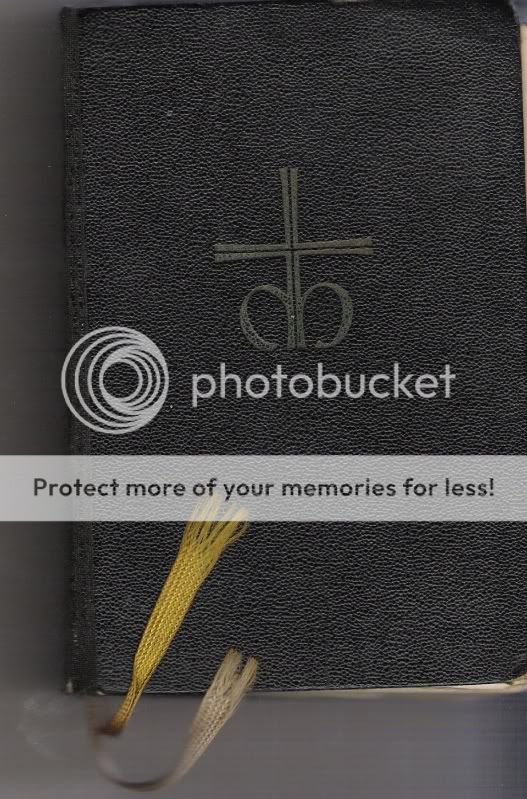
The Magnifikat is basically a prayer book or a missal. It contains for the most part the songs that you sing in mass, but it also the full Catholic liturgy in Latin and German plus explanations. It's a small black book (not good to scan) with gilt edging and 2 ribbon bookmarks. You carried it with you to mass, and during mass a board would tell you which song numbers you'd need for that particular mass.


The name of the book means praise of God derived from "Magnificat anima mea Dominum", "my soul praises the Lord." Sometime in the mid 70s the book was abrogated and replaced by the "Gotteslob" which was a de-Latinized version. Gotteslob would be the German expression for Magnfikat.

The Magnifikat also contained instructions for confession including a preparatory questionairre with some very obvious questions and funning wording...After the Confessional we'd get a leaflet, usually with a picture and a prayer inside as proof that we've been there. On occasion the priest or your parenets would ask to present that proof. My edition is full of these leaflets:


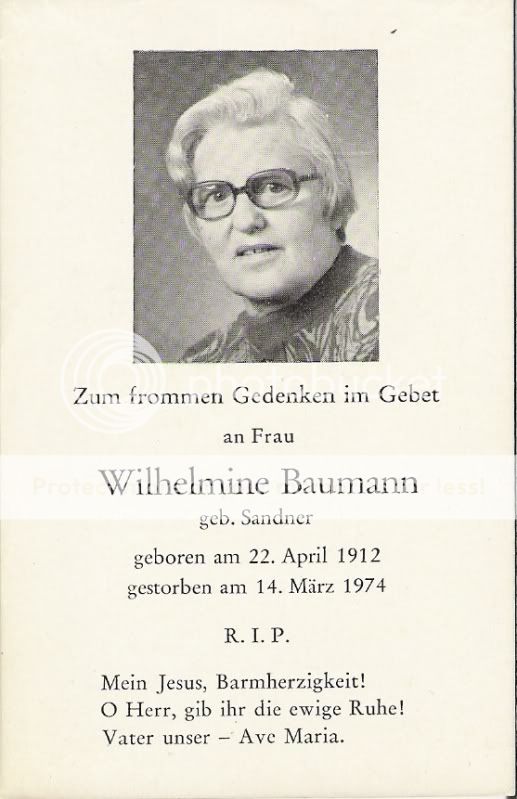
It also still holds all those pics from funerals I have attended, this one is my German grandmother's 'death picture':


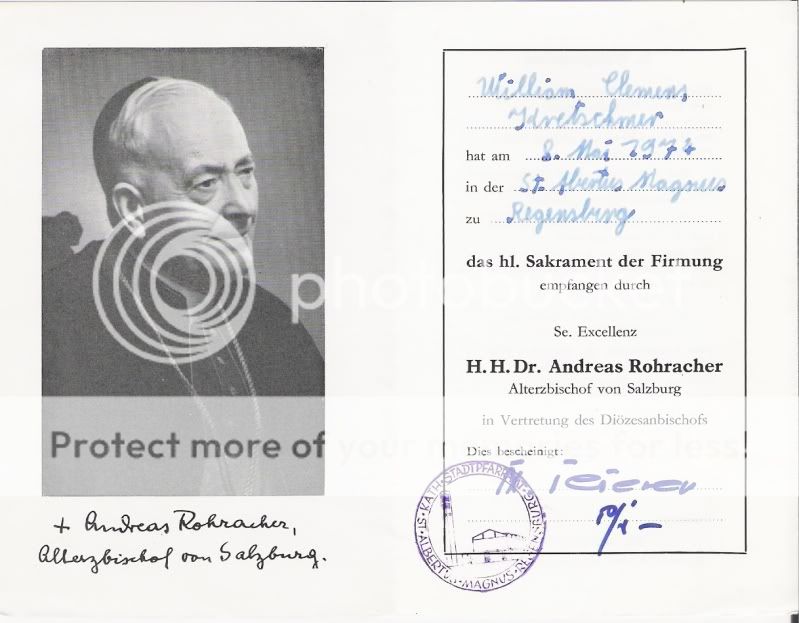
Looking through my old edition I also found this document, proof of my confirmation:


So this book isn't really dear to me, but I keep it (plus other prayer books) as a remembrance from my childhood.

Sunday, May 31, 2009

Books of My Life: Reclams Filmführer

Reclams Filmführer Dieter Krusche/Jürgen Labenski Stuttgart: Philipp Reclam jun., 2nd ed. 1973 


I've always loved movies, to this day cinema has been an essential part of my life. Even as a kid I'd study the movie section of the TV Guide and mark the ones I wanted to see, mostly monster movies and science fiction, of course, but a lot of classics as well. I just wasn't aware that they were classics then. I'm still searching for a few titles I saw as a kid, but can't figure out what they were. And my dad took me to the movies a lot, 2001: A Space Odyssey in 1968 was a very memorable experience. (My theory is that you should show that movie to kids, they can appreciate it much better). It was only later - having moved to Germany in the mean time - that I realized that movies were something that could be called art. The Godfather, Part 2 in 1974 kind of blew my mind, I became seriously interested in 'studying' movies. This means that I started reading reviews and books on cinema and systematically chose what I wanted to see. I'm still doing that even today... The Reclams Filmführer might have been the first book on cinema that I bought, and I've read it dozens of times and used it for work many times since. Basically it is a dictionary of the most important movies in cinema history. It is subdivided in a section for the silent era and one for movies with sound, but includes a large section presenting the most important directors, what their work meant for cinema history and a list of their essential films (unfortunately incomplete). The new editions have no subsections aynmore, and the directors part was deleted, but published separately as a book. By and by I worked on seeing every title in the book (which I still haven't managed yet). When I was older and joined the local film club and its cinema I used this book as a source to organize retrospectives. Each movie is introduced with short credits, a full synopsis and an appreciation why this specific work has any relevance within cinema history. This information proved to be important, if I wanted to have a title on our program, and it gave me the elements with which I could argue. Naturally the selection is biased by the author's preferences, and Hollywood pics are lined up in equal measure with world cinema. Even though it's supposed to include the main works of cinema, some IMHO are missing and there are quite a few obscure titles listed, often barely known. I'm still urging to see Vilgot Sjöman's 491, the description was quite shocking to me in the mid 70s. Neverthless, this single book introduced me to cinema as art and to the names of all the great directors. In a few years after buying the book I had managed to see the major works of Pier-Paolo Pasolini, Ingmar Bergman, Roberto Rossellini, Federico Fellini, Andrej Tarkovsky, etc., and re-introduced to the more important Hollywood directors. I also have a more recent updated edition of this book, but my old one is still dear to me. 

Werner Herzog's Auch Zwerge haben klein angefangen (1969) 

Pier-Paolo Pasolini's Teorema (1968) 


Luis Bunuel's La vida criminal de Archibaldo de la Cruz (1955) 


A page from my edition (director's section)