Sunday, December 21, 2008

Uwe Johnson: Jahrestage


This is a monumental 4-volume novel written by the German author Uwe Johnson between 1970 and 1983, the title in English is 'Anniversaries', although the German word also simply means the days of a year. As a teen I always planned to read this book, even though it was then not yet completed, and for years it was also quite uncertain whether Johnson would be able to finish the final 4th volume. He died only a few months after its final publication. So recently I started to collect the 4 volumes, and my copy of volume one is incidentally signed by the author. That's the book I'm currently reading.

You can find a very good description and analysis of the novel here

The synopsis from there reads:

The novel covers, day by day, a year in the life of Gesine Cresspahl, beginning 21 August 1967, and concluding 20 August 1968. Johnson anchors the narrative in the present-day, making Gesine a dedicated and somewhat obsessive reader of The New York Times, and so there are many references to the stories of the day, most every day, and often longer excerpts from the newspaper. At the same time, Gesine is providing a (more or less chronological) account of her past to her ten-year-old daughter, Marie, and there are also present-day domestic scenes from their lives.

The present-day plot of the novel is situated in New York City where Gesine Cresspahl lives with her daughter. However, the story (if you could call it as such) wanders back and forth through time and very much tells us about how Gesine's parents got married in Germany in the early 30s, her childhood all through the third reich, World War II, the occupation though the Sowjets and life in communist East Germany. This is all set against 'present-day' USA (i.e. in 1968) and engulfs the American history of that era, especially the Vietnam war.

Sunday, December 14, 2008

Regensburg by night

The Cathedral


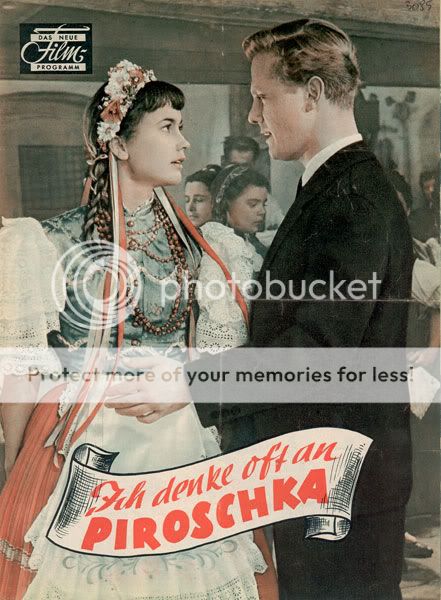
Ich denke oft an Piroschka (1955)


A German exchange student on his way to Hungary falls in love with a girl he meets in Budapest. Arriving at his destiny, a small Hungarian village, he falls for the station master's daughter, who takes his attention more seriously than he intends. Eventually the two girls find out about each other, and the student should make a decision...

This movie is a typical example and is considered a classic of the German genre of Heimatfilm. Therefore the story is deeply steeped in a whole world of shoddiness, false sentimenality and racial and cultural bias which has made this genre often unbearable for me to watch. The German student appears to origin from a superior culture, and the Hungarian people are colourful and lovable for all their fallacies, but are also shown as backward, unreliable and lazy, more interested in wine, drink and dance than in anything 'substantial'. Likewise, this German student is actually just having a summer affair between his studies, a forgivable 'adventure' before he becomes a full member of the hard-working German 'civilization'. All through this movie you feel the reverberations of the Nazi ideology hardly overcome just a decade before this movie was made. In several scenes I consider the student's behaviour downright despicable.

But what makes this movie not quite so unbearable as my words above make it sound is Liselotte Pulver! You quickly forget the falsehood of a Swiss woman playing a pagan Hungarian girl (with a fake accent on top of that!), cause she just radiates beauty and a personal naturalness that's all hers and kind of transcends the blunt cliches of the whole story. She's also the most complex and therefore realistic character in the movie, and all throughout you yearn to take her by the hand and free her from that Aryan imbecile...

Saturday, December 13, 2008

Quicksand (2003)


The workaholic head of the compliance section of a New York bank flies to Monaco to investigate unusual deposits from an offshore bank and meets a down-on-his-luck international film star who has become embroiled in criminal activities.

To be honest, don't let the credentials fool you: directed by John MacKenzie and starring Michael Keaton and Michael Caine this is nevertheless just an average (and very predictable) late night thriller.

Natalia Vodianova

Species (1995)


A group of four specialists are given the task of tracking down Sil. "She" is part human, part alien, beautiful, strong, very dangerous and desperate to mate with a human.

I'd suggest to avoid this one unless you're desperate and have nothing better to do...

Maria Full of Grace (2004)


In a small village in Colombia, the pregnant seventeen years old Maria (Catalina Sandino Moreno) supports her family with her salary working in a floriculture. She is fired and with a total lack of perspective of finding a new job, she decides to accept the offer to work as a drug mule, flying to USA with sixty-two pellets of cocaine in her stomach. Once in New York, things do not happen as planned.

If you haven't seen it yet: I can recommend this movie! Don't let the synopsis scare you away, the movie is much less harrowing than the average CSI episode. Moreover, it is made with a simple realism, and in the end it is the story of a woman's emancipation.